.jpg)
TGS is a global provider of advanced energy data and intelligence, serving companies across the entire energy value chain.
The company is headquartered in Oslo and Houston, with nearly 2,000 employees and offices around the world. Their data library spans oil and gas basins as well as wind, solar, and carbon capture.
In July 2024, TGS merged with PGS. Overnight, the combined business spanned 66 legal entities and around 3,400 active suppliers. Together, their combined annual spend was close to USD 1 billion.
A merger of that scale brings both opportunity and complexity. For procurement, this came down to one question. How do you get control of a billion dollars in spend across 2 companies that have never worked as one?
The challenge: No single view across a newly merged business
When TGS and PGS came together, no one had a clear view of the combined spend.
The data sat in 3 separate systems, SAP, IFS, and Oracle Fusion, and none of them talked to each other. They had different supplier coding conventions and different categorization logic.
That made everyday procurement harder than it should have been.
Every sourcing decision was made on its own, with no leverage from the full scale of the business. Duplication was hard to spot, and finance and leadership had no unified procurement data for vessel cost or CAPEX and OPEX reporting.
The 2 organizations also had separate supplier and contract management systems, which added another layer of complexity.
For a merger to pay off, procurement had to move fast.
Part of the challenge was technical. The team had to bring data together from 3 systems. Part of it was organizational, creating a common language and one program to manage nearly USD 1 billion in spend around the world.
What changed: From 3 systems to one clear picture
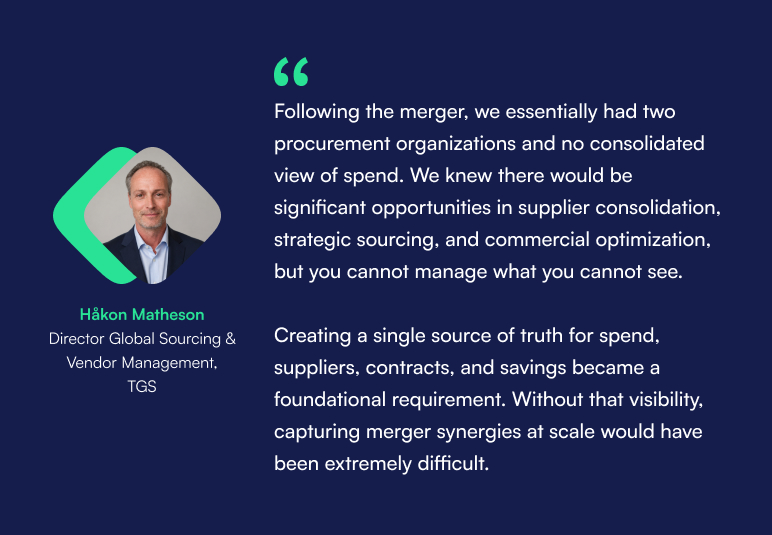
Håkon Matheson, Director Global Sourcing & Vendor Management, led the work with his team. They moved quickly.
They chose Ignite to bring their procurement data from 3 systems together in one place. Spend analytics, supplier management, contracts, and savings tracking no longer had to live in separate tools. They could sit on a shared foundation, connected and working together.
The separate supplier and contract management systems were also consolidated into Ignite, which gave TGS a stable base as they work through their wider ERP move to SAP S/4HANA.
A single spend cube across 3 systems
The team pulled transaction data from all 3 systems into Ignite and harmonized it across 66 legal entities.
It was substantial work: cleaning the data, mapping the entities, and sorting every supplier and spend line into a category. Legacy data was often incomplete.
Ignite gave them a place to make practical calls and keep moving. The result was one view of all their spend, something the merged business was missing.
.jpg)
Cleaning up and categorizing the supplier base
The team started with around 3,700 suppliers from the merger and worked through them one by one in Ignite. They categorized 96% of the supplier base.
It enabled them to see category insights across both pre-merger organizations. This made supplier consolidation and cross-entity category strategies possible.
Category management and savings
With the spend cube in place, the team built category management across both legacy organizations.
Now, they could run sourcing strategies at the full scale of the merged business. Ignite's savings management capabilities tracked and validated the results. That gave the team a clear, traceable record of what was committed and what was delivered.
In a newly merged business, every number is under scrutiny. Being able to show exactly where the value came from mattered as much as the value itself.
.jpg)
Procurement visible at board level
The team aligned the procurement taxonomy with how Finance views costs, like vessel cost and CAPEX and OPEX reporting. Procurement performance became part of the official financial picture, and not a separate dashboard.
Spend, savings, and supplier data all sit in Ignite. That lets the team run a monthly reporting cycle, giving leadership a clear view of spend, savings, suppliers, and category progress.
Key results
Most organizations take years to reach this point.
TGS built the spend visibility, supplier structure, and category management in the first year of a major merger.
The team started with 3 disconnected systems and no shared view. They ended with one connected picture of the business, and real commercial value to show for it.
- ~40M USD in contracted savings registered in the first full year
- ~999M USD in combined annual spend consolidated into a single spend cube
- ~3,400 suppliers active and categorized in Ignite
- 3 systems unified into one procurement platform
- Monthly procurement reporting embedded in the company's financial picture
.jpg)


.jpg)
.jpg)