Ask most procurement teams how confident they are in their spend data, and you'll get a pause before the answer.
Procurement data is almost always imperfect. It comes from multiple systems, gets entered by different people in different formats, and often originates in sources that procurement doesn't own or control. This is the reality of how most organizations are set up.
The instinct is to clean it up before starting. But data quality is never fully complete. New transactions come in every day, formats change, and the baseline keeps shifting.
Good analysis starts with workable data and a process that keeps improving it over time. This post explains what that looks like in practice.
Why procurement data is fragmented and hard to trust Several factors contribute to data fragmentation in procurement:
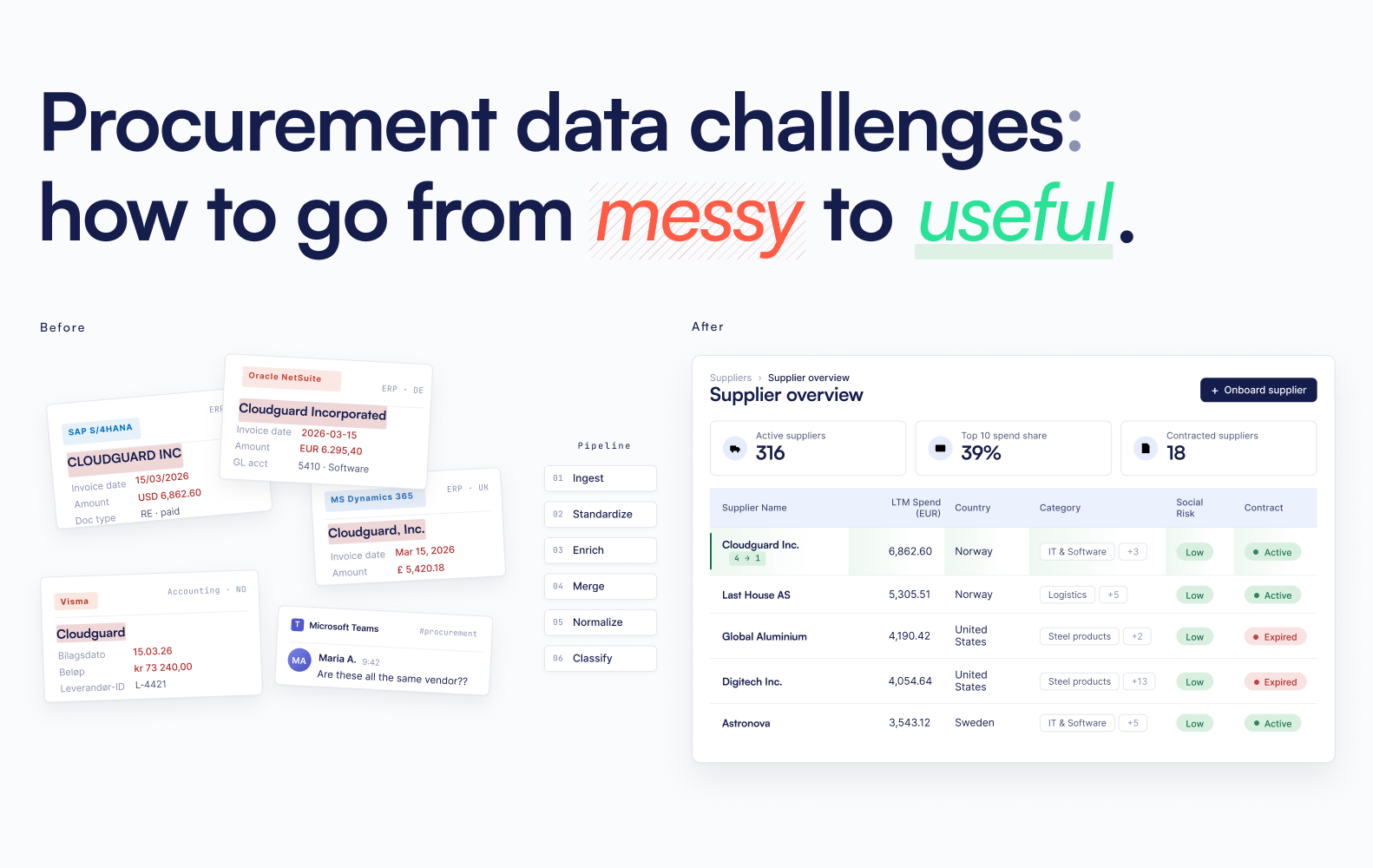
Multiple systems, no shared standard. Data comes from a combination of ERPs, data lakes, accounting platforms, and other tools that weren't built to connect. A single ERP is usually internally consistent. Dates, currencies, and formats tend to be clean within one system. The problems arise when you consolidate across multiple ERPs, where the same fields are structured differently and there's no shared standard to reconcile them against. Invoice data is often the dirtiest. Invoices are filled out by suppliers, not your team. Free text fields, inconsistent descriptions, and varying formats mean invoice data can come into your system in many different ways and that variation is hard to control. Multiple users, multiple inputs. Across business units and geographies, different people enter data differently. One team writes "Johnson Controls." Another writes "Johnson Controls Inc." A third writes "J. Controls." All three are the same supplier. In most systems, they show up as three separate entities. Data owned by other functions. A significant portion of procurement data originates in finance or accounting systems that procurement teams use but don't control. They can't clean it at source or restructure it, and often have limited visibility into how it was entered.Complexity from M&A and growth. In post-merger or multi-country environments, inherited systems and naming conventions add further fragmentation. Some organizations work with 60 or more data sources across multiple countries and business units.No finish line. New spend data comes in constantly. Data quality is never a one-time fix.What makes it hard to get clean procurement data? Data errors tend to fall into predictable patterns. Here are the ones we see most often:
Duplicate supplier names. Siemens, Siemens AG, and Siemens A.G. are the same supplier. Without normalization, they appear as separate entities with spend split across all of them, making supplier analysis and consolidation opportunities hard to see.Inconsistent date formats. Whether a date reads 1-15-23 or 15-1-23 depends on who entered it and where they're based. In international environments, this creates comparability problems that are easy to miss.Vague or misleading category descriptions. "Services" could mean plumbing, auditing, legal fees, or IT support. Without consistent categorization, spend analysis tells you very little.Different document languages or broken characters. Common in multi-country environments, and a barrier to reliable automated classification if not handled properly.Incorrect currencies. Spend entered in local currencies without consistent conversion makes comparisons across business units unreliable.These errors are hard to catch manually because they hide in volume. A procurement team processing tens of thousands of transactions a year won't find a duplicate supplier entry by scrolling through a spreadsheet.
And errors compound. One bad category label leads to a miscategorized supplier, which leads to a missed consolidation opportunity, which leads to a savings figure that nobody fully trusts.
When to start analysis, and what the data actually needs to be The instinct to clean data before starting analysis makes sense. Garbage in, garbage out, and analysis built on completely disconnected data produces results that mislead more than they inform.
But the bar is good enough, not perfect. Data that can be extracted and connected across your main sources is enough to start. It doesn't need to be fully categorized, consistently formatted, or free of duplicates before analysis can begin.
A practical way to approach this: start with the source you trust most. If you have three ERPs and one of them is significantly cleaner than the others, begin there. Build your foundation on the data you're most confident in, then bring in the other sources and clean as you go. Each source you add improves the picture without requiring everything to be perfect upfront.
Analysis and cleansing can happen at the same time. You don't need to finish one before starting the other. Teams can begin working with their data, and continue cleaning and refining it alongside the analysis.
Waiting for clean data creates a moving target. New transactions come in every day, new suppliers get added, and the baseline keeps shifting.
Starting with what you have and improving as you go is how data quality gets built.
One procurement leader put it well: "You don't need perfect data to start building trust." Her team started reporting with what they had, were transparent about its limitations, and found that transparency increased their credibility internally.
How to improve your procurement data accuracy A well-structured cleansing process handles most of the complexity systematically, and much of it can be automated.
When raw data comes into a platform like Ignite, it moves through a sequence of steps before it's analysis-ready. The output is structured, comparable, and reliable enough to support analysis and decision-making from day one. It gets more reliable over time as the process runs continuously and the team refines classifications and corrects errors.
The first steps happen at the source level. Each data source gets processed individually before anything is merged:
Select data sources. Ignite meets your data where it is. During implementation, the team works with you to connect data from whatever sources are in use: SAP, Visma, CSV, REST API, SFTP, and more.Parse and standardize. Dates, currencies, and formats get normalized regardless of source. Whether data came from SAP, Visma, a CSV file, or a REST API, it gets converted into a consistent structure.Enrich. Reference data gets added to fill gaps and improve classification accuracy. External data sources and AI add context that wasn't in the original records.Filter. Non-procurement transactions get removed. Finance entries, intercompany transfers, and other irrelevant data points distort baseline calculations. Filtering them out keeps the analysis focused on addressable spend.Merge. Everything comes together into a unified, analysis-ready table. Supplier and contract data links to spend. Emissions factors integrate where needed. All entities are visible in one place with consistent structure.Once each source has been cleaned and standardized, the next steps work across all the data together:
Map to categories. Spend gets classified against a consistent taxonomy. AI handles classification at scale, with human review applied throughout to keep accuracy high. One user described the impact on their day-to-day work: "With Ignite's AI classification, I was able to do what would normally take a full business day in less than an hour. In the last few days alone, I've classified a couple million euros of spend and a couple thousand transactions, and it took minutes, not hours." Apply org hierarchy labels. Data gets tagged with the right business unit, region, or entity labels so every view is filterable by the organizational structure that matters to your team.Normalize suppliers. Duplicate supplier entries get merged into single, clean records. Siemens, Siemens AG, and Siemens A.G. become one supplier, giving you an accurate view of total spend and making consolidation opportunities visible.
The IT effort involved tends to be lighter than expected. A team that recently integrated from Unit4 via push API estimated the work at around 20 hours. The actual effort came in at 5 hours.
How to maintain procurement data quality over time Data quality is a continuous process, even when you have the right tools. New spend comes in constantly, suppliers change, and organizational structures evolve. Treating it as a one-time cleanup project means starting over regularly.
In Ignite, AI and automation can now handle a growing share of the ongoing work. AI suggests how spend should be classified, and gets more accurate as it learns from the data. Supplier merging catches new duplicates as they appear. Human review stays in the loop for decisions that require judgment.
The volume of manual work decreases over time. Every month of data processed means more patterns learned, more classifications refined, and more errors corrected.
Teams that start earlier build this capability faster.
If you want to see how Ignite handles your data specifically, book a walkthrough here .


.jpg)